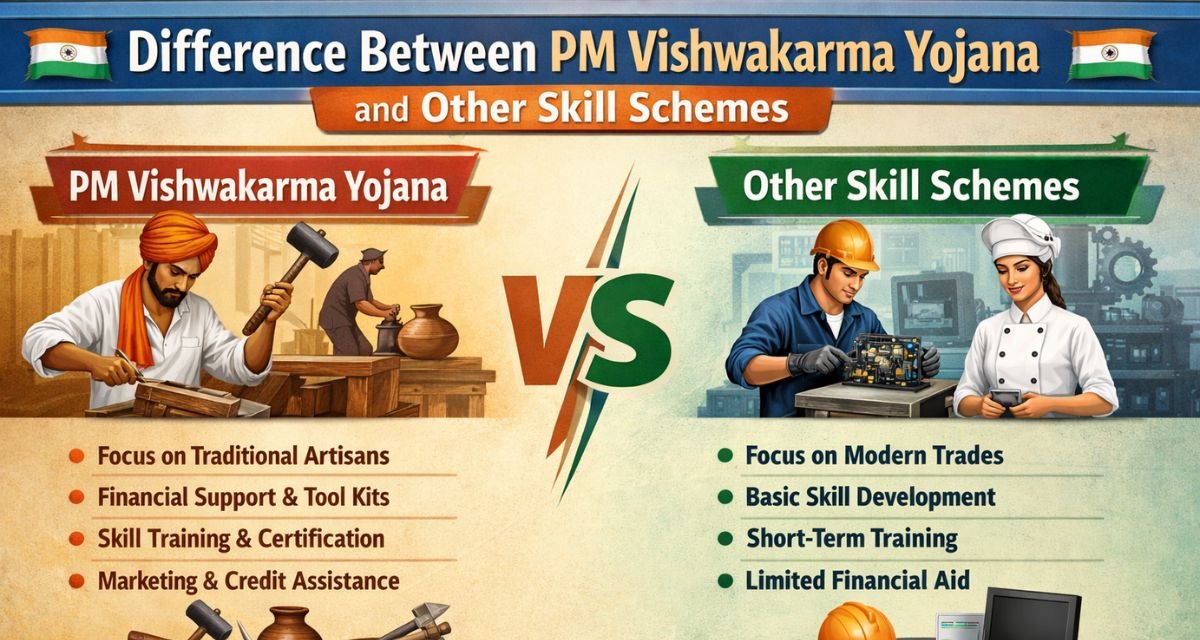
The Indian government runs a lot of programs to help people learn new skills and make more money. The PM Vishwakarma Yojana is a special program for traditional artisans and craftspeople. There are other well-known skill programs as well, such as Skill India, PMKVY (Pradhan Mantri Kaushal Vikas Yojana), the Mudra Loan Scheme, and the Stand-Up India Scheme.
A lot of people don’t know which scheme is best for them. This article uses simple language to explain the differences between PM Vishwakarma Yojana and other skill programs.
What does PM Vishwakarma Yojana mean?
The government started the PM Vishwakarma Yojana to help traditional workers and artisans like carpenters, blacksmiths, tailors, barbers, cobblers, and other skilled workers.
This plan focuses on:
- Getting better at traditional skills
- Giving training
- Giving money help
- Helping artists make their businesses bigger
- This plan is different from others because it is made for people who work with their hands and traditional tools.
Purpose Comparison
What is the PM Vishwakarma Yojana?
The main goal of PM Vishwakarma Yojana is to help traditional artists and craftsmen. A lot of these workers already know how to do things, but they don’t have the right tools, training, or money.
This plan helps them:
Get better at their traditional skills
Get training that is up to date
Get better tools
Make their small business bigger
Make more money
The plan also wants to keep traditional skills alive that are slowly fading away.
Other Skill Schemes Purpose
Other government skill schemes focus mainly on providing new skills and job opportunities. These schemes aim to reduce unemployment and help youth find jobs in different industries.
For example:
PMKVY (Pradhan Mantri Kaushal Vikas Yojana)
- Provides skill training to unemployed youth
- Helps people get jobs in companies
- Offers certification after training
Skill India Mission
- Focuses on large-scale skill development
- Trains youth for various industries
- Encourages employment opportunities
Mudra Loan Scheme
- Provides loans to small businesses
- Helps people start new businesses
- No skill training provided
Key Purpose Difference
- PM Vishwakarma Yojana focuses on traditional artisans and self-employment
- Other Skill Schemes focus mainly on job training and employment
This is the biggest difference between PM Vishwakarma Yojana and other schemes.
Benefit Comparison
Benefits of PM Vishwakarma Yojana
PM Vishwakarma Yojana provides many benefits to artisans:
- Free skill training
- Daily stipend during training
- Financial support for tools
- Low-interest loan
- Business support
- Digital payment training
- Marketing support
Under this scheme, beneficiaries can get:
- Tool kit incentive
- Training allowance
- Loan support up to ₹3 lakh in stages
This makes PM Vishwakarma Yojana very helpful for small traditional workers.
Benefits of Other Skill Schemes
PMKVY Benefits
- Free training
- Skill certification
- Placement assistance
- Industry-related courses
Skill India Benefits
- Various skill training programs
- Job-oriented courses
- Certification after completion
Mudra Loan Scheme Benefits
- Business loan without collateral
- Financial support for startups
- Loan categories: Shishu, Kishore, Tarun
Key Benefit Difference
- PM Vishwakarma Yojana provides training + tools + loans + business support
- Other schemes usually provide only training or loan
This makes PM Vishwakarma Yojana more complete and practical for artisans.
Eligibility Differences
PM Vishwakarma Yojana Eligibility
To apply for PM Vishwakarma Yojana, the applicant must:
- Be an Indian citizen
- Be involved in traditional trade or craft
- Work as self-employed artisan
- Be at least 18 years old
- Belong to Vishwakarma category trades
Some examples of eligible trades:
- Carpenter
- Tailor
- Barber
- Cobbler
- Goldsmith
- Blacksmith
- Potter
- Mason
This scheme is mainly for traditional skilled workers.
Other Skill Schemes Eligibility
PMKVY Eligibility
- Youth above 18 years
- School dropouts
- Unemployed candidates
- Anyone willing to learn new skills
Skill India Eligibility
- Open to most citizens
- Students and job seekers
- No requirement of traditional skill
Mudra Loan Eligibility
- Small business owners
- Startup founders
- Entrepreneurs
Key Eligibility Difference
- PM Vishwakarma Yojana is limited to traditional artisans
- Other schemes are open to a wider group of people
Who Should Choose the Scheme?
You should choose PM Vishwakarma Yojana if:
- You are a traditional artisan
- You already have a skill
- You want to grow your small business
- You need tools and financial support
- You want to improve your traditional work
This scheme is best for:
- Carpenters
- Tailors
- Barbers
- Mechanics
- Handicraft workers
- Small artisans
Choose Other Skill Schemes If
You should choose other schemes if:
- You want to learn a new skill
- You are looking for a job
- You want to start a new business
- You do not have any traditional skill
These schemes are best for:
- Students
- Job seekers
- Freshers
- Entrepreneurs
Final Conclusion
PM Vishwakarma Yojana is a unique scheme designed especially for traditional artisans and craftspeople. It provides skill training, financial help, tools, and business support in one place. This makes it different from other government skill schemes. On the other hand, other skill schemes focus mainly on training, employment, or loans. They are suitable for students, job seekers, and people who want to learn new skills.
Before choosing any scheme, you should understand your needs and goals. If you are a traditional artisan, PM Vishwakarma Yojana is the best option. But if you want to learn a new skill or find a job, other skill schemes may be better for you. Both types of schemes are helpful and aim to improve employment and income opportunities for people across India.